
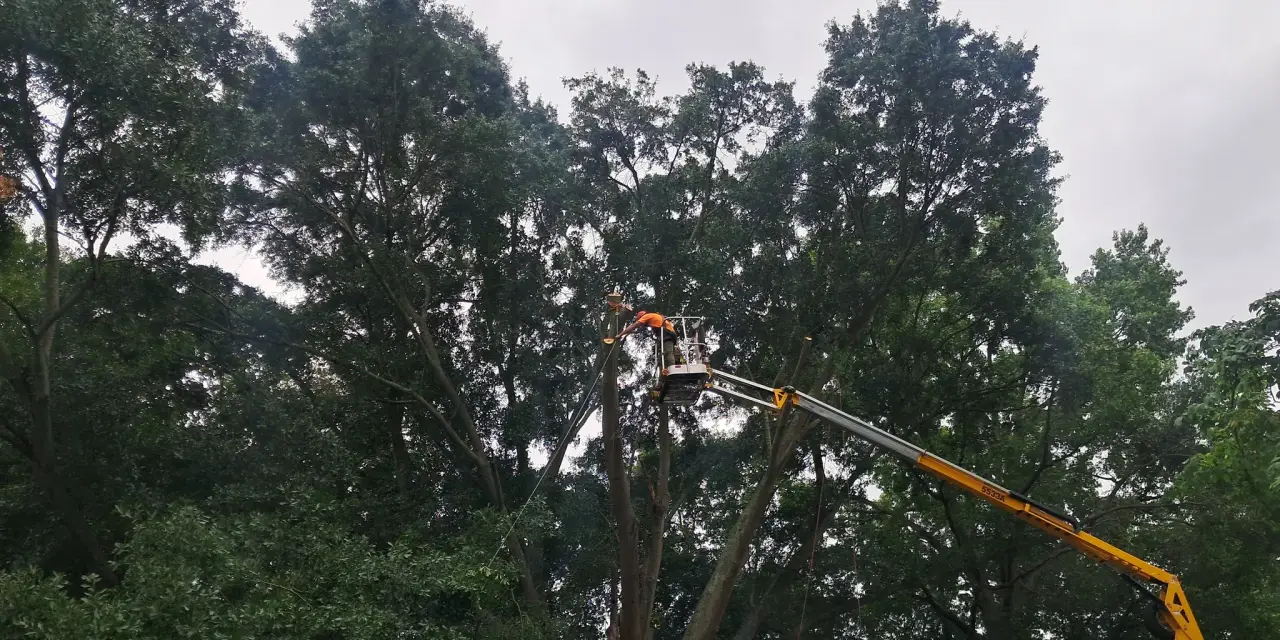
04 / Precision Ops in Constrained Environments
There is no room for the tree to fall. Take it down anyway.
Crane assisted tree removal on federal land, airspade and carbide root removal, and operations on terrain up to 70 degrees and inside archaeological zones.
The job is not cutting the tree
A tree over an occupied structure, a root ball inside an unexcavated battlefield earthwork, or a slope no machine can stand on is not a variation on a standard job. These are a different category of work where the constraint defines the method. The tree is not the problem. The space around the tree is the problem, and the job is controlling exactly where every pound of it goes.
That means crane picks planned to the piece, rigging built from the ground up, and root systems excavated with air instead of ground with blades. We work where the margin between a clean removal and a damaged resource is measured in inches, and where the wrong tool disqualifies you before you start.
What We Deliver
Six crane assisted tree removal and rigging capabilities for federal land where nothing can fall free
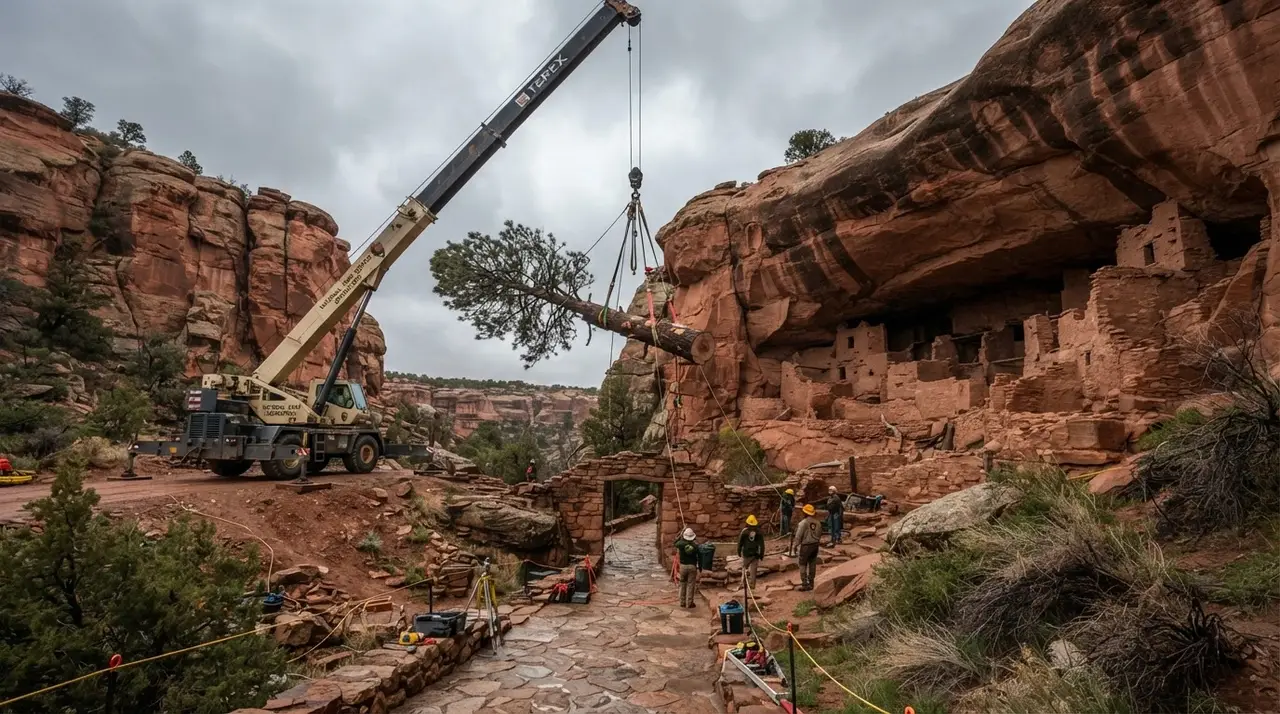
Crane-assisted extraction and pick planning over occupied structures
When a tree stands over a visitor center, a headstone row, or a structure that cannot be moved, we bring a crane and plan every pick before the boom swings. Each piece is weighed, rigged, and lifted to a landing zone that is cleared before the cut starts. The crane operator and the climber are on the same radio. Nothing is improvised.
Sectional dismantling and advanced rigging where no drop zone exists
On a constrained site there is no place for the tree to fall. We take it apart in sections, each piece rigged to a rope system that lowers it under control. Speed lines, friction savers, and portawraps manage the descent. The rigging plan is built from what is underneath the tree, not from what is fastest.
Airspade and carbide root removal on protected archaeological ground
A stump grinder is a machine that chews soil. On unexcavated archaeological earthworks, that is disqualifying. We use an airspade to excavate the root ball with compressed air, exposing the structure without cutting it, then remove it with carbide-tipped tools that cut root material without disturbing the surrounding matrix.
Steep slope operations on terrain from 60 to more than 70 degrees
On ravine slopes where no machine can stand, the crew works on rope. We anchor above the tree, set the climber on a static line, and rig every piece to a system that keeps it from rolling down the slope. The slope is not an obstacle. It is a constraint that changes the rigging plan from the first cut.
ATAK-enabled targeting and site mapping in constrained access
On a site where access is limited by terrain, structures, or archaeological sensitivity, we use ATAK to map the hazard trees, the access routes, and the exclusion zones before equipment arrives. The crew sees the same map the planner sees. Picks are sequenced by location, not by convenience.
Load calculation and controlled-descent rigging
Every rigged piece has a calculated weight before it is cut. We factor the species, the moisture content, and the piece geometry to set the rigging system within its working load. If the number does not work, the piece gets cut smaller. The math runs before the saw does.
The Hardest Problem in This Lane
Fort Donelson National Battlefield
Fort Donelson National Battlefield is 160 acres of unexcavated Civil War earthworks. The ground holds the archaeological record of a fortification built and fought over in 1862. 122 hazard trees stood across that ground, their root systems threaded through the earthworks themselves. The trees had to come down. The earthworks could not be disturbed.
A conventional stump grinder is disqualifying on this ground. A grinder is a machine that drives a carbide wheel into the stump and the soil around it, churning everything in its path into mulch. On unexcavated earthworks, that path is the archaeological resource. The wheel does not distinguish between root wood and a soil stain that marks where a parapet wall stood 160 years ago. Once the matrix is ground, the record is gone.
An airspade does the opposite. It uses a focused stream of compressed air to excavate soil without cutting it. The air displaces particles but does not sever them, so the soil structure and any artifact or feature it holds stays intact. We used the airspade to expose each root ball, then removed the root material with carbide-tipped cutting tools that cut root wood without touching the surrounding ground. The earthworks were left undisturbed. Zero ground disturbance to the archaeological resource across all 122 removals.
That is the difference this lane turns on. The tree comes out. The ground stays. The method is dictated by what is underneath, and what is underneath is not replaceable.
Read the full federal recordWhere This Applies
Federal land where the constraint defines the method
National Battlefields and Archaeological Sites
See the federal record for this market.Historic Structures and Visitor Centers
See the federal record for this market.National Cemeteries and Headstone Rows
See the federal record for this market.Steep Terrain and Ravine Slopes
See the federal record for this market.Next Step
When the tree cannot fall, the plan has to hold
Download the capability statement for precision operations in constrained environments on federal land. The full capability statement, past performance summary, and federal registration data are available as a single document. For teaming opportunities, see how we work with partners.
Federal Registration
Ready to mobilize
| Field | Value |
|---|---|
| UEI | GZ3XMZPPKA59 |
| CAGE | 9NKZ6 |
| Primary NAICS | 561730 |
| Additional NAICS | 115310 and 113310 |
| PSC | F014 S208 F018 |
| SAM.gov Status | Active |
The Arborist is a Service-Disabled Veteran-Owned Small Business serving federally managed land across the United States.